
The Nearness of God
Israel My Glory In Depth is a video interview series that explores the author’s motivation in writing their article.Believers in Messiah Jesus constitute a different type of temple and can worship God any time and any place because of a special gift: the indwelling Holy Spirit.
The wages of sin is death, and the essence of death is separation. When a person dies physically, his spirit separates from his body. When he dies spiritually, his entire self separates from his Creator. In Genesis 3, Adam and Eve rebelled against God and, in so doing, thrust the entire human race into a state of sinfulness and fallenness. At that point, both forms of death became operative: We human beings became physically mortal, and a barrier sprang up between us and our Creator (graphically and poignantly depicted by Adam and Eve’s expulsion from Eden).
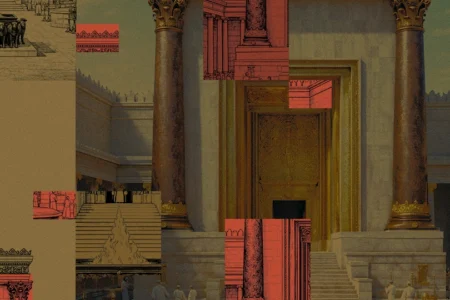
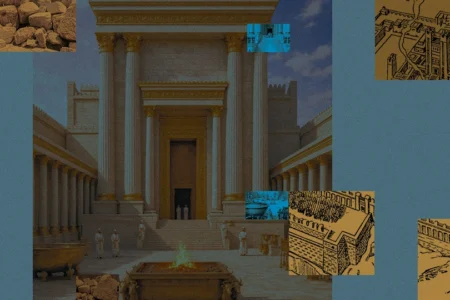
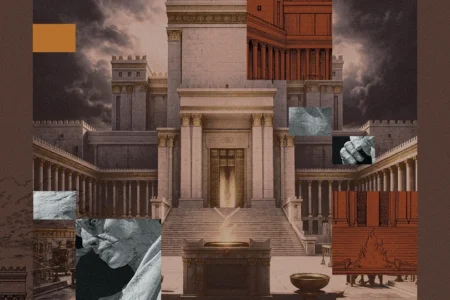
Later, in the Bible’s unfolding account, God came to dwell among His people—first in the Tabernacle, then in the Temple. This was a major development in God’s dealings with mankind: Finally, it seemed like our separation from God was being remedied.
But the remedy proved to be only partial and provisional. Although God again resided with His people in an observable, localized way, the underlying problem of human sinfulness remained unresolved. And so, even while He manifested His presence in Israel’s midst, God always had to keep the Israelites at arm’s length. So, there it stood: a massive veil, imposing and unyielding, barring the way into the holy of holies where God’s presence dwelt. The separation endured. God had come so close, yet He was still so far away.
Eventually, the Israelites’ sins became so egregious that even this partial, restricted manifestation of God’s presence had to be withdrawn. As the Jewish people were being carted away into captivity in Babylon, God’s glorious presence departed from Solomon’s Temple, rose up into the sky, and disappeared over the eastern horizon (Ezek. 10—11). It never returned—at least, not in the familiar form of a pillar of cloud, resplendent in glory and radiant in dazzling light.
Instead, God clothed Himself with flesh. He became a man: Jesus of Nazareth. And when Jesus embraced death on a cross to deal with our sin problem once and for all, something dramatic happened to the Temple’s veil that separated man from the holy of holies. The Gospel writers record that, just as Jesus was committing His spirit into the hands of God the Father, “the veil of the temple was torn in two from top to bottom” (Mt. 27:51; Mk. 15:38; cf. Lk. 23:45). The way was opened. The barrier between humanity and God had finally been removed. A new era had dawned; and in this Church Age, there would be no more need for physical temples or animal sacrifices.
A Woman, a Well, and a Way Forward
This paradigm shift must have seemed shocking and unconventional to the first generation of Christians, most of whom were Jewish with a thoroughly Jewish heritage.
But so much about Jesus had been shocking and unconventional. In fact, Jesus had predicted the Temple system’s soon abolition. In a conversation with a Samaritan woman at a well (Jn. 4), a longstanding doctrinal disagreement between the Jews and Samaritans bubbled to the surface: The Jews believed God had chosen Mount Moriah in Jerusalem as the authorized place for Temple worship, whereas the Samaritans insisted it was Mount Gerizim.
Perceiving that Jesus possessed supernatural insight (and perhaps attempting to derail the conversation when it seemed to be getting a little too personal), the woman asked Jesus’ opinion. His was a brand-new teaching that sidestepped the doctrinal impasse altogether and charted a new path forward: “The hour is coming when you will neither on this mountain [Gerizim], nor in Jerusalem, worship the Father,” for “the true worshipers will worship the Father in spirit and truth” (vv. 21, 23).
In other words, worship in the coming dispensation would not have to be localized. It would no longer be restricted by geography or architecture. Worshipers would no longer need to make arduous pilgrimages to holy sites to engage in authorized worship. Instead, believers would be able to engage in proper, authorized worship of God anywhere and everywhere. Why? Because He soon would give them the Holy Spirit, who “dwells with you and will be in you” (14:17).
Incarnate Temples and Living Stones
Just as God had previously taken up residence within the physical walls of Solomon’s Temple, He would now take up residence within every individual believer. This would be accomplished through the Holy Spirit’s ministry of indwelling.
The moment people believe in Jesus for the forgiveness of their sins, the Holy Spirit enters them, thereafter to indwell them permanently (Rom. 8:9; 2 Cor. 1:22). Thus, the concept of temple takes on an entirely different shape and significance in the Church Age dispensation. No longer is a temple a physical place to which believers must go; rather, believers themselves are the temple. The apostle Paul made this point in two ways when writing to the Corinthians:
First, as he encouraged the saints in Corinth to forsake their petty, divisive bickering and instead pursue unity and harmony, he wrote, “Do you not know that you [plural] are the temple of God and that the Spirit of God dwells in you?” (1 Cor. 3:16). The entire congregation, considered collectively, could thus be characterized as a metaphorical temple. Whenever the believers came together, they formed a gathering of people who were all indwelt by the same Holy Spirit. In that sense, they constituted a type of temple in whose midst was the very presence of God.
Then later, in the same epistle, as Paul exhorted the Corinthians to forsake sexually immoral practices and lifestyles, he wrote, “Or do you not know that your body is the temple of the Holy Spirit who is in you?” (6:19). Here, the emphasis is individual, not collective. Each believer—every man, woman, and child who has been redeemed by Jesus Christ—can be thought of as an incarnate, localized temple. That truth, of course, has profound ethical implications: It would not be proper to deface God’s temples by involving them in the very sins Jesus died to deliver them from.
The apostle Peter also drew on temple imagery to describe the relationship of Church Age believers to their Creator. Envisioning the church as a temple and each believer as a component in that structure, he wrote, “You also, as living stones, are being built up a spiritual house, a holy priesthood, to offer up spiritual sacrifices acceptable to God through Jesus Christ” (1 Pet. 2:5).
Let Us Come Boldly
Too often, we may underappreciate the immense riches of spiritual blessings that God has bestowed on us in the Church Age. Consider just a few of the practical implications that flow from this church-as-living-temple dynamic:
→ We have the privilege of worshiping God anytime, anywhere. We don’t have to wait for a specially appointed day or seek out holy ground or a holy building to commune with God.
→ We are not separated from Him any longer; instead, God Himself dwells within us.
→ We don’t need to offer animal sacrifices on an altar; instead, God accepts our words of praise as suitable sacrifices (Heb. 13:15).
→ We no longer need a special class of consecrated human priests to serve as intermediaries between our Creator and His worshipers; instead, every believer in Jesus Christ has immediate access to God and can appeal to Him directly.
Through prayer, we are able to “come boldly to the throne of grace, that we may obtain mercy and find grace to help in time of need” (4:16). We have immediate access to God. We are no longer separated from Him. And that is probably the greatest blessing of all.




Very good article; helps one understand how Jesus spoke about the coming changes to worship.