From Babylon to Rome
A look at the Second Temple, the entity some called the epicenter of the Jewish world.
Like bookends, sorrow frames the history of the Second Temple. When its foundation was laid following the return of some of the Jewish exiles from Babylon, many wailed bitterly, seeing how much smaller it was than Solomon’s Temple (Ezra 3:12). Today, the destruction of the Second Temple in AD 70, almost 2,000 years ago, still reigns powerfully in the Jewish psyche.
And why shouldn’t it? The Second Temple bore witness to Jewish life for nearly six centuries, and its elimination represents the ongoing tragedy of Jewish loss.
The Return to Rebuild
Prior to Israel’s exile to Babylon, God promised His people He would return them to their land after 70 years of captivity (Jer. 29:10–14). In 538 BC, He stirred the heart of Cyrus the Great of Persia, conqueror of Babylon, to allow the Jewish people to return to Jerusalem and rebuild the Temple (2 Chr. 36:22–23).
Under the leadership of Zerubbabel, nearly 50,000 Jewish people went home (Ezra 1:1–4; 6:1–5), bringing with them the 5,400 gold and silver vessels that King Nebuchadnezzar had carted off to Babylon (1:7–11).
Temple construction began in 535 BC. Sidonians and Tyrians were hired to transport cedars of Lebanon by sea to Joppa, while Levites aged 20 and above oversaw the work (3:7–8). But opposition soon followed. The Samaritans (descendants of people Assyria moved into the land; they intermarried with Jews there) offered their help, claiming to worship the God of Israel as part of their syncretic religion. Their offer was refused, provoking them to accuse the Jews of plotting rebellion. Consequently, Persian King Artaxerxes halted construction altogether (4:11–24).
Eventually, God raised up the prophets Haggai and Zechariah to call the people back to obedience. With the support of Persian King Darius I, who even subsidized the project through local taxes (6:8), construction resumed. The Temple was completed and dedicated in 516 BC, nearly 20 years after the Jewish exiles’ return.
Even so, disappointment lingered. Many who remembered the opulence of Solomon’s Temple wept when they saw the Second Temple (3:12), which was modest and had no Ark of the Covenant, no Shekinah Glory, no cherubim, and no adjacent royal compound.
Yet, God still chose to place His name there. Through Haggai, He declared, “The glory of this latter temple shall be greater than the former. . . . And in this place I will give peace” (Hag. 2:9). That promise must have seemed impossible to those who had seen Solomon’s Temple.
Few could have imagined that centuries later, God Himself would enter that building in human flesh and proclaim that salvation had come.
The Gentile Takeover
Though the Temple stood as the center of worship of the one true God, it was also the national symbol of Israel and thus a trophy for those who sought to conquer the Jewish people.
Antiochus IV (Epiphanes) was one such ruler. As king of the Seleucid Empire—a successor state of Alexander the Great’s Greek dominion—Antiochus ruled much of the ancient Near East, including Israel. In 168 BC, returning from a failed campaign in Egypt, he turned his attention toward Jerusalem.
A vicious, twisted, evil ruler who thought himself a god, Antiochus viewed the Jewish population as rebellious. He outlawed core Jewish practices under penalty of death, slaughtered about 80,000 Jews, and deported thousands more. His assault culminated in the Temple’s desecration: He plundered its treasures, erected an image of Zeus within its courts, and defiled the altar by sacrificing a pig on it.
This crisis forced a choice: obedience to a pagan ruler or faithfulness to the God of Israel. Some chose assimilation; others refused to compromise. Among the stalwarts were the Maccabees, who led a successful revolt, reclaimed Jerusalem, cleansed the Temple, and rededicated it to the worship of Yahweh—an event commemorated by Hanukkah.
The Hasmonean Dynasty emerged from the Maccabean revolt and assumed control of both monarchy and priesthood. Over time, however, what began as a righteous movement degenerated into corruption and internal strife, drawing the attention of Rome, the rising power that soon eclipsed the Seleucid Empire.
In 63 BC, Roman General Pompey intervened, captured Jerusalem, and stormed the Temple Mount. He even entered the holy of holies, only to find it empty—the Ark having disappeared in the Babylonian exile. Reportedly declaring, “It is empty; there is nothing there but darkness,” Pompey subdued the city but spared the Temple from destruction.
Rome later installed Antipater the Idumean as ruler over Judea. After Antipater’s death, authority passed to his son Herod—later known as Herod the Great—whose reign would reshape Jerusalem and the Temple itself.
The Expansion
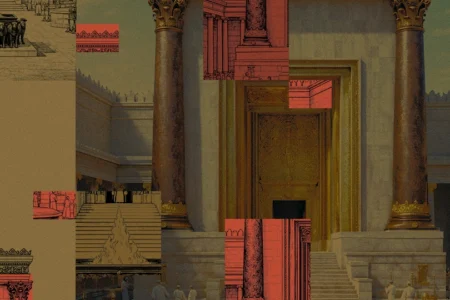
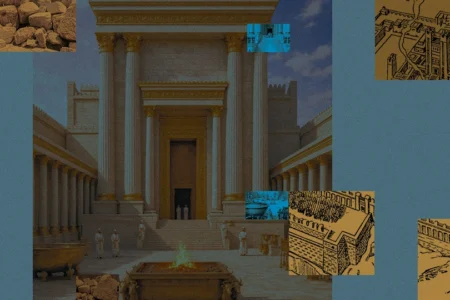
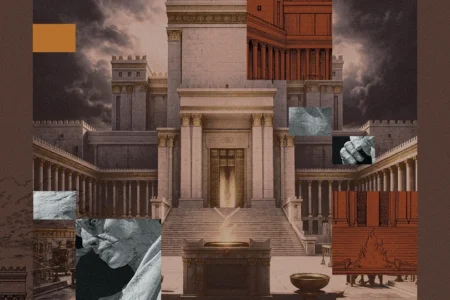
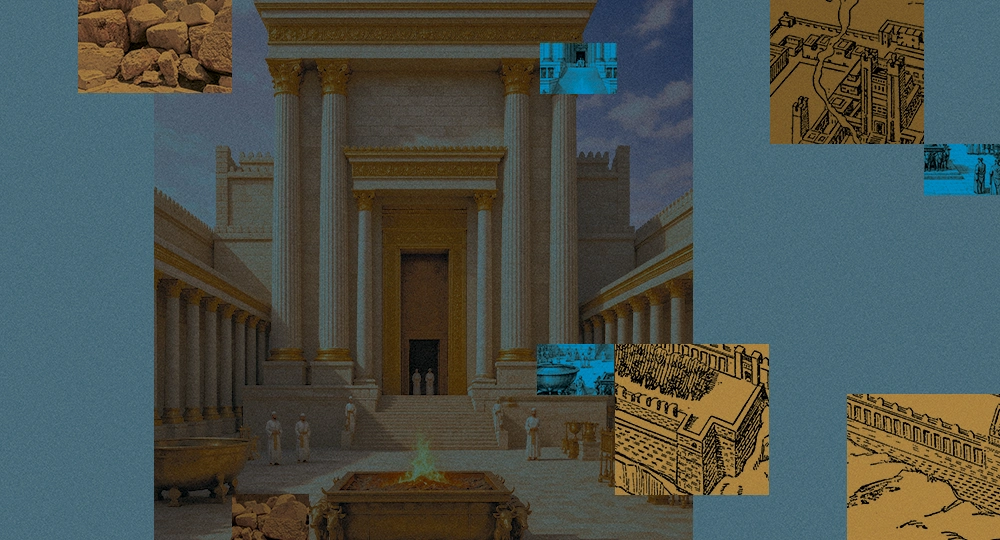
As king of Judea under Roman authority, Herod embarked on many vast building projects. Yet, his most ambitious undertaking was the renovation and expansion of the aging Second Temple, which he began around 20 BC.
Within 17 months, Herod completed the Temple building itself, though construction on the surrounding complex would continue for decades, never to be completed.1 The renovated structure—commonly called Herod’s Temple—was spectacular. It featured ornate gates; distinct courts for Gentiles, women, Jewish men, and priests; and expansive porticoes, including the massive Royal Stoa supported by 162 pillars.2
All this magnificence stood atop an enormous platform of roughly 35 acres, supported by massive foundation stones, some weighing hundreds of tons. So impressive was the Temple complex that the Talmud records, “One who has not seen Herod’s building has never seen a beautiful building in his life.”
The Second Temple in the New Testament
It is this Temple that dominates the New Testament, particularly in the Gospels.
From the outset of His earthly life, Jesus the Messiah was closely associated with the Second Temple, fulfilling God’s promise that this Temple would possess greater glory and that there, He would “give peace” (Hag. 2:9).
Shortly after Jesus’ birth, Mary and Joseph brought Him to the Temple in obedience to the Law of Moses (Lk. 2:22–27, 39). Simeon and Anna, two righteous Jewish people, recognized the Infant as the long-awaited Messiah. Years later, at age 12, Jesus returned to the Temple during Passover and astonished the teachers with His understanding (vv. 41–49).
Following Jesus’ baptism, Satan tempted Him at the Temple pinnacle, urging Him to test God’s protection—a challenge He rebuffed with Scripture (Mt. 4:5–7). Throughout His ministry, Jesus taught regularly in the Temple courts, confronting religious leaders and proclaiming truth (Mk. 12:35; Lk. 22:52–53; Jn. 8:20; 10:1–39).
On what we today call Palm Sunday, He entered Jerusalem and cleansed the Temple, driving out the money changers and declaring that God’s house was meant to be a place of prayer, not exploitation (Mt. 21:13). Ultimately, His actions led to false accusations, including the claim that He intended to destroy the Temple and rebuild it in three days (26:61).
His most sobering words came when He foretold the Temple’s destruction. As the disciples marveled at the building’s splendor, Jesus replied, “Do you not see all these things? Assuredly, I say to you, not one stone shall be left here upon another, that shall not be thrown down” (24:2).
The Destruction
Jesus’ prophecy was fulfilled in AD 70. The Roman-Jewish War had erupted four years earlier, fueled by Jewish resistance to Roman rule. Rome responded with its characteristic brutality. In April of AD 70, Roman General Titus arrived with an army of 48,000 to 67,000 soldiers and placed Jerusalem under siege.3
Four months later, Roman forces burned the Temple; looted its treasures; and desecrated it by offering sacrifices to their military standards, mocking the God of Israel while exalting their own power.4
Just as Jesus had foretold, the Second Temple—the emblem of Jewish identity—was gone. Its loss was more than a military defeat; it was a devastating blow to the Jewish people. Their national sovereignty, sacrificial system, and very identity lay buried beneath the smoldering rubble.
The agony of that summer day on the 9th of Av is still felt today. This year, many Jewish people around the world will fast for 24 hours beginning at sundown on July 22, Tisha B’Av, to mourn the Temple’s loss. At Jewish weddings, the bridegroom stomps on a glass at the end of the ceremony as a reminder of the Temple’s destruction. Thus, even at the most joyous moments in Jewish life, sorrow is never far away.
The bookends are always there; and for many Orthodox Jews, the question is not if the Temple should be rebuilt, but when.
ENDNOTES
- Barry Strauss, Jews vs. Rome: Two Centuries of Rebellion Against the World’s Mightiest Empire (New York, NY: Simon & Schuster, 2025), 30.
- Randall Price, Rose Guide to the Temple (Carol Stream, IL: Rose Publishing, 2012), 73.
- Strauss, 153.
- Ibid, 167.