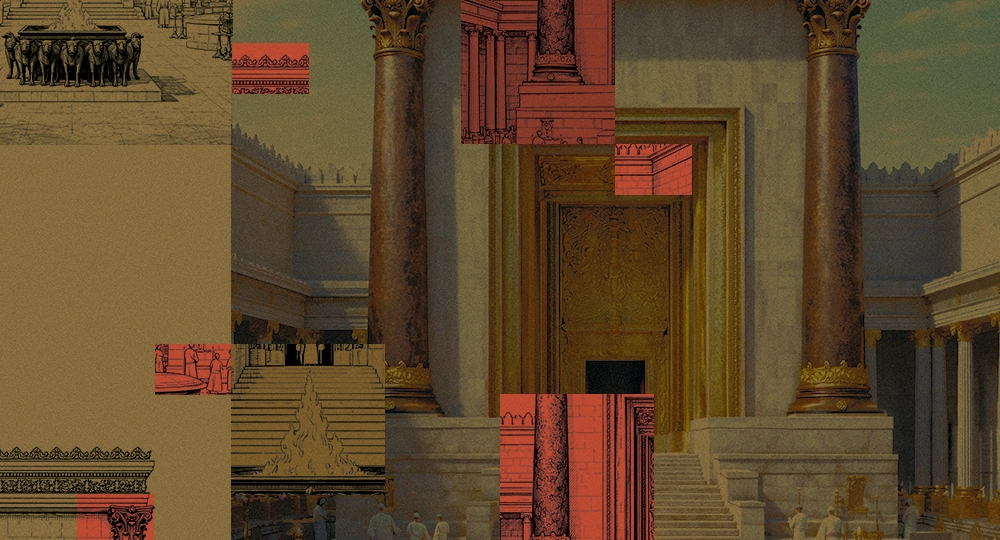
Solomon’s Temple
No place on Earth is as special to God as Jerusalem, and no place in Jerusalem is as special to Him as the site of the Temple. He said so Himself.
Jerusalem is often called a holy city, but its holiness does not come from the events that happened within it. It comes from God Himself, who made it holy by choosing to place His name and His presence there. This choice became clear when Solomon’s Temple was built, not simply as a religious monument of Israel’s golden age, but as the place where the God of Israel chose to dwell among His people. The Temple is central to the Bible not because of its beauty but, rather, because of God. As Scripture says, “For the LORD has chosen Zion; He has desired it for His dwelling place” (Ps. 132:13).
This choice was not random. Solomon’s Temple was built on Mount Zion, identified with Mount Moriah, a mountain already shaped by God’s actions and covenant history (Gen. 22). Mount Zion was God’s deliberate choice. He set this place apart as one that would remain close to His heart forever.
When the Temple was completed, God explicitly confirmed its unique status. Speaking to Israel’s King Solomon, He declared, “I have consecrated this house which you have built, by putting My name there forever, and My eyes and My heart will be there always” (1 Ki. 9:3, NASB). No other place on Earth is spoken of in this way. In this remarkable statement, God declared that His name, His eyes, and His heart will remain there forever. Even when Israel later experienced exile and loss, God remained faithful to His purposes for this place. His plans for it continued, showing that His commitment transcended Israel’s failures and judgment.
At the same time, Scripture presents Solomon’s Temple as more than a national sanctuary. From this chosen place, God’s rule was meant to reach beyond Israel. The prophets looked to Mount Zion as the source of God’s teaching and just rule for all nations: “For out of Zion shall go forth the law, and the word of the LORD from Jerusalem” (Isa. 2:3). The Temple was a divine model where God’s presence and rule were established in Israel, while reaching outward to the whole world.
Because of this broader purpose, Jerusalem’s status as God’s chosen dwelling place still matters today. The Bible’s claim is not simply that Jerusalem is historically important, but that God chose Mount Zion as the place of His presence and rule. Any discussion about Jerusalem, its status, or its future must begin with a proper understanding of God’s final purposes for it.
The Construction of Solomon’s Temple
The biblical descriptions of Solomon’s Temple in 1 Kings 6 and 2 Chronicles 3—5 are striking not only for their detail, but also for their restraint. The text does not glorify Solomon as an architect or visionary; instead, it emphasizes obedience. The Temple was built following God’s precise instructions, showing that worship begins by listening to God, not by expressing ourselves.
Preparation and order mattered; even beauty served the purpose of honoring God, rather than the worshiper. The design helped people show respect while taking what is holy seriously.
A detail often overlooked is the silence surrounding the construction: “No hammer or chisel or any iron tool was heard in the temple while it was being built” (1 Ki. 6:7). God’s dwelling place arose without the sounds of violence or force. In this light, it is significant that King David, though devoted to the Lord, was not permitted to build the Temple because of the bloodshed associated with his reign (1 Chr. 22:8). The Temple was to arise from peace, rather than war.
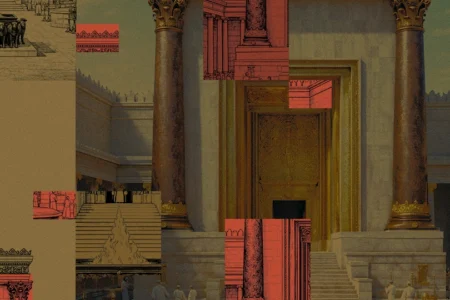
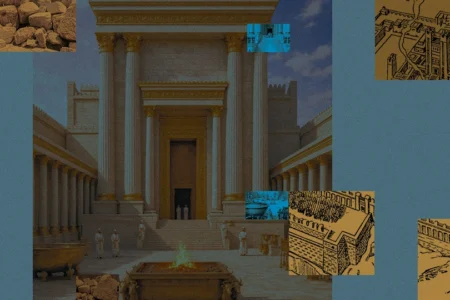
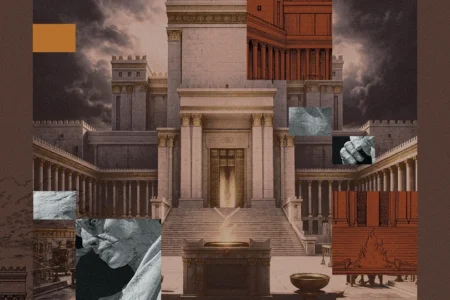
The structure itself reflected increasing sanctity as one moved inward. Cedar and gold adorned the interior, with the greatest concentration of gold in the holy of holies, where the Ark of the Covenant rested. This movement toward God’s presence progressed from east to west, turning the Israelites away from sun-centered worship common in surrounding cultures and toward the unseen God, who could not be represented by any created power or object.
The Glory of God Fills the Temple
The most decisive moment in the history of Solomon’s Temple came not at its completion but, rather, at its dedication. As the Ark of the Covenant was brought into the holy of holies and worship filled the courts, God Himself responded: “And it came to pass, when the priests came out of the holy place, that the cloud filled the house of the Lord, so that the priests could not continue ministering because of the cloud; for the glory of the Lord filled the house of the LORD” (1 Ki. 8:10–11).
The Bible presents the Lord’s “glory” (Hebrew, kavod) as a visible, overwhelming reality. Human activity ceased, and worship gave way to awe. The same Shekinah Glory that had filled the Tabernacle in the wilderness now filled the Temple, but with a crucial difference: In the wilderness, the glory moved ahead of the people, guiding them in their unfinished journey. Here, however, the glory did not lead onward; it rested.
Nachmanides, a famous 13th-century rabbi, observed that redemption from Egypt reached its fulfillment not in movement, but in arrival. The resting of the She-kinah in the Temple signaled that Israel had reached the place God intended. The God who once led His people now lived with them, calling them to stop and worship before Him.
Theological Meaning of the First Temple
The First Temple stood as a visible testimony to God’s desire to dwell with humanity. In this way, it pointed back to the perfect model seen in the Garden of Eden, where God walked with Adam and Eve in direct fellowship.
This time, however, a sacrifice was necessary to approach a perfect and holy God. At the heart of the Temple’s life was sacrifice—not as an empty ritual, but as a constant reminder that sinful people can approach a holy God only through atonement provided by God Himself.
The daily burnt offering, presented morning and evening, reinforced this truth. Its continual presence reminded Israel that forgiveness and sanctification were ongoing needs, not occasional acts. Life before God required regular repentance and dependence on His mercy.
The Temple site itself embodied this truth. Long before the structure was built, God had commanded Abraham to go to Mount Moriah and to sacrifice his son Isaac (Gen. 22). When God saw Abraham’s obedience, He provided an animal substitute, showing that forgiveness comes from Him alone, not from what people do.
With the coming of the Messiah, the sacrificial system reached its fulfillment. Through His once-for-all sacrifice, Jesus made it possible for God’s people to again approach Him without restriction. Although there is no Temple today, the core principles remain. The New Testament teaches that forgiveness still comes through atonement, and God’s people are still called to lives of holiness, offering themselves as “a living and holy sacrifice” (Rom. 12:1, NASB) and walking in continual repentance (1 Jn. 1:9).
Loss, Departure, and Hope
After standing for almost 400 years, Solomon’s Temple was destroyed by the Babylonians in 586 BC as a result of Israel’s persistent idolatry and covenant unfaithfulness. Around the time of its destruction, the prophet Ezekiel described the glory of the Lord rising from the Temple and departing from Jerusalem (Ezek. 10:18–19; 11:22–23). This departure was not permanent but judicial, a consequence of sin, rather than a failure of God’s purposes.
If this were the final word, it would contradict God’s eternal purpose for this place. But Ezekiel also foresaw the return of the glory. In a later vision, the Lord’s glory comes from the east and fills the house again (43:1–5), pointing beyond judgment to restoration.
Therefore, Solomon’s Temple was a glimpse of the future glory, but not its full expression. A day is still coming when sin will be no more and God will dwell with His people again.