How Tall Was Goliath? (Part 1)
Exactly how tall was Goliath, the Philistine giant slain by David the shepherd boy (1 Sam. 17:1–54)? While the Masoretic (Hebrew) text lists his height as “six cubits and a span” (v. 4), the Bible uses two different types of cubit: royal and standard. Scholars believe King Solomon employed the royal cubit in constructing the First Temple shortly after the Goliath account.
However, Moses first recorded the Israelite royal cubit in an Egyptian context. If based on the Egyptian regal cubit, determined by the length between a pharaoh’s elbow and tip of his middle finger, the royal cubit measured 20.72 inches. A “span” is half a cubit—in this case, 10.36 inches. Adding six of these cubits and a span totals a height around 11 feet 3 inches. However, most scholars use the standard cubit (18 inches) and generally set the giant’s height between 9 feet 6 inches and 9 feet 9 inches.
A distinctly different measurement recorded in later texts and versions of the Hebrew text equate Goliath’s measurement to roughly 6 feet 9 inches, complicating the debate. Based on the height of entrance doors in Iron Age four-room houses, the average Israelite at this time was around 5 feet 6 inches; and a younger David may have been even shorter. By comparison, even a 6-foot-9-inch opponent might have appeared to be a giant.
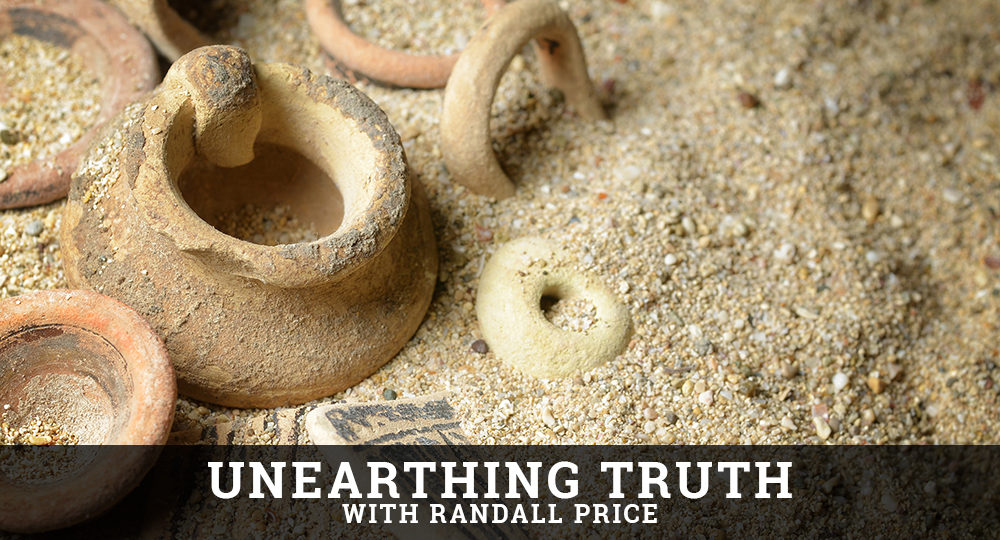
Archaeology helps us determine the correct measurement first by affirming the literal nature of the biblical account. We already have seen in previous “Unearthing Truth” articles how archaeology has validated Israelite Kings Saul and David as real, historical figures.1 The name Goliath appears in an inscription (on an ostraca or potsherd) from his hometown of Gath (now identified as Tell es-Safi).2 Written in archaic “Proto-Canaanite” letters, it contains two non-Semitic names: Alwt and Wlt, Philistine renderings of “Goliath.” Although the inscription is dated to the 10th century BC, one century after Goliath’s time, his famous name would have been preserved in the town’s history.
In 2019, excavations at Tell es-Safi/Gath revealed enormous architecture and fortifications within a layer of the Philistine city from the 11th century BC, when David slew Goliath. Its massive fortification walls are termed “Cyclopean Walls” because the Greek philosopher Aristotle thought such stones could only have been moved by the Cyclopes, who were legendary giants. Though excavation director Aren Maeir does not believe Philistine giants existed, he confessed “only giants could move” such stones. Thus, he proposed that the huge fortifications may have created the perception (and the legend) that giants lived there.3
The best explanation for this colossal construction, found nowhere else in the Levant (a geographic region that includes Israel, Jordan, Lebanon, and Syria) from this period, is the Bible’s record of the giant Goliath’s family of mother and five sons as residents of Gath. The Hebrew text describes “a man of great stature, who had six fingers on each hand and six toes on each foot, twenty-four in number; and he also was born to the giant. These four were born to the giant in Gath, and fell by the hand of David” (2 Sam. 21:20, 22).
These members of Goliath’s family had polydactyly, a birth defect resulting in extra digits on the hands and feet. This mutation has been paired with that of gigantism. In 2014, two medical geneticists suggested that Goliath and his kin likely had a hereditary autosomal dominant pituitary gene that resulted in hyperthyroidism or acromegaly.4 This abnormality resulted in both conditions. Thus, this eyewitness detail recorded in Scripture is confirmed by science 3,000 years later.
In the next issue of Israel My Glory, we will conclude our study of archaeology’s confirmation of Goliath’s height.
Endnotes
- See Randall Price, “Digging Up King Saul,” Israel My Glory 82, no. 1 (2024): 35, and “Digging Up King David,” Israel My Glory 82, no. 2 (2024): 35.
- Aren Maeir, “An Iron Age IIA Proto-Canaanite, Philistine Inscription and Other New Finds from Tell es-Safi-Gath,” a paper presented to the annual meetings of the American Schools of Oriental Research, Philadelphia, PA (November 18, 2005).
- Amanda Borschel-Dan, “Colossal Ancient Structures Found at Gath May Explain Origin of Story of Goliath,” The Times of Israel, July 26, 2019 (tinyurl.com/GathWalls).
- Donnelly and Morrison, “Hereditary Gigantism—the Biblical Giant Goliath and His Brothers,” Ulster Medical Journal 83, no. 2 (2014): 86–88.