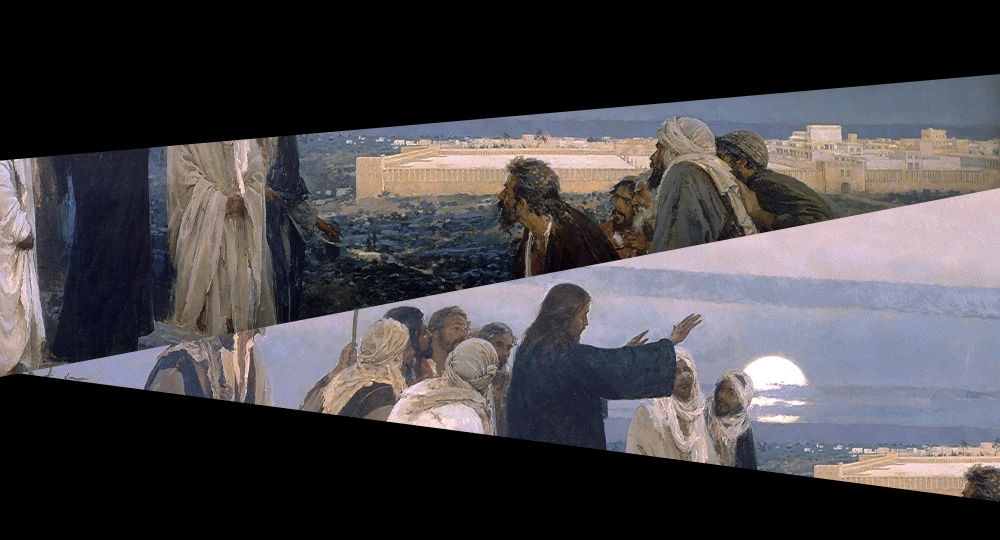
The Olivet Discourse
An overview of the near view and far view of a prophecy that involves judgment, deliverance/salvation, and restoration.
The Olivet Discourse represents the Lord Jesus Christ’s largest, most detailed prophetic discourse. On the Mount of Olives overlooking the historic Jewish Temple, Jesus instructed His disciples about events concerning Israel that will find their final fulfillment with His return at the end of the age.
Contextual Setting
Only the Synoptic Gospels (Matthew, Mark, and Luke) record this discourse (Mt. 24—25; Mk. 13; Lk. 21). It is important to understand the contextual setting for Jesus’ revelation of the future, which involves both judgment and deliverance/salvation.
Matthew provided this context in his account of Jesus’ rebuke following national rejection of Him as Israel’s Messiah (chaps. 22—23). In these chapters, Jesus said Israel’s leaders’ rejection of Him (22:15–46) placed the nation in the company of previous generations of Israelites who rejected the warnings of God’s prophets, which resulted in divine judgment (23:29–36). This legal sentence was contained in Israel’s covenant with the Lord, which the nation promised to obey (Ex. 24:7). Violating it through national disobedience specified consequences of increasing levels of divine discipline (Lev. 26:14–22) climaxed by foreign invasion, devastation, and exile (vv. 23–39).
The immediate context of the discourse referred to the near judgment that would be executed by the Romans in AD 70. The finality of it from the divine perspective is seen in Jesus’ declaration from the Mount of Olives (Mt. 23:37–39) that the nation was beyond repentance (v. 37). Two other points appear in Jesus’ pronouncement: (1) The desolation would be centered on the Temple, which symbolized God’s covenant relationship with Israel (v. 38; cf. Ex. 25:8–9, 22); and (2) the judgment was not permanent but “until” the nation repents and accepts Jesus as Messiah: “I say to you, you shall see Me no more till you say ‘Blessed is He who comes in the name of the Lord!'” (Mt. 23:39; cf. Ps. 118:22–29).
Jesus came as Messiah in “the name of the LORD”; but only when the nation calls on “the name of the LORD” (Joel 2:32; cf. Rom. 10:13), recognizing Him as its blessed Messiah (Zech. 12:10), will it experience salvation/deliverance and restoration (Isa. 59:20; cf. Rom. 11:27). Another “until” appears in Luke 21:24 regarding the prophetic timeline from the AD 70 judgment by the nations to the end-times judgment of the nations: “And they will fall by the edge of the sword, and be led away captive into all nations. And Jerusalem will be trampled by Gentiles until the times of the Gentiles are fulfilled.”
These “untils” remind us that the Olivet Discourse prophecy deals with both a near and far fulfillment concerning Israel.
Historical Setting
Jesus’ prediction of rejection and judgment, coupled with the historical setting, led the disciples to question when this judgment would take place and how it fit with predicted end-times events.
Each of the Synoptic Gospels presents Jesus and His disciples’ tour of the Temple Mount at the close of His earthly ministry as the basis for the Olivet Discourse (Mt. 24:1; Mk. 13:1; Lk. 21:5). The disciples were enamored by the beauty of the Herodian edifice and their nation’s votive gifts (Mk. 13:1; Lk. 21:5). Jesus’ statement that both Jerusalem and the Temple would be reduced to rubble (Mt. 24:2; Mk. 13:2; Lk. 21:6) and much of the population killed (Lk. 19:44) shocked the disciples and elicited their subsequent questions and His prophetic answer.
Events Recorded in the Olivet Discourse
The disciples’ confusion over Jesus’ words led them to ask Him privately several pivotal questions concerning fulfillment of prophetic events (Mt. 24:3; Mk. 13:4; Lk. 21:7). The first question, “Tell us, when will these things be?” (Mt. 24:3) appears to address the immediate concern for Jerusalem and the Temple. The second question, “What will be the sign of Your coming, and of the end of the age?” (v. 3), appears to address the broader, future events surrounding the Messianic advent.
All the events in Jesus’ answer were drawn from the Old Testament, and they concerned Israel’s promised future. Jesus’ use of the Old Testament should instruct us that our interpretation should be both literal and viewed within the timeframe associated with national Israel—not the Church Age. The Jewish request for a “sign” (cf. Jn. 2:18; 1 Cor. 1:22), the mention of the Jewish Temple (Mt. 24:15; cf. Dan. 9:27), Jewish persecution (Mt. 24:16–22; cf. Zech. 12:2; 14:2), and the Jewish tribes’ rescue and restoration (Mt. 24:30–31; cf. Isa.11:4–5, 11–12; 59:16–21) as signal events should provide interpretive boundaries for the entire discourse finding fulfillment exclusively with and for national Israel.
The Gentile judgment that concludes the Olivet Discourse, with its condition for reception or rejection that has often been used as an ethic for the Church Age, comes only after Messiah’s return at the end of the Tribulation (see “Signs of the Times“) and is accompanied by national Israel’s repentance and salvation (Mt. 25:31–46).
The first question, though mentioned in all the Synoptic Gospels, is highlighted by Luke’s phrasing: “What sign will there be when these things are about to take place?” (Lk. 21:7). And it is in Luke’s account the answer is given with respect to the near fulfillment of the AD 70 siege and destruction of Jerusalem (vv. 20–24).
Again, because Luke’s Gospel records Jesus’ precise timetable concerning Jerusalem’s “trampling by the Gentiles” (said to continue “until the times of the Gentiles are fulfilled,” v. 24), it is evident that this is an intended diversion from His answer to the second question (21:8–19, 25–28) concerning the far future. Clues are the use of the term great distress (v. 23) instead of great tribulation (Mt. 24:21; cf. Mk. 13:19), and the focus of “wrath upon this people [Israel]” (Lk. 21:23) instead of “redemption” for Israel (v. 28; cf. Mt. 24:29–32; Mk. 13:26–27).
Structure of the Olivet Discourse
Jesus structured His answer on the prophet Daniel’s timeline of the 70 weeks prophecy (Dan. 9:24–27), which forecast His crucifixion and Rome’s destruction of Jerusalem in AD 70 (v. 26). (See “The Amazing Prophecy of the 70 Weeks of Daniel” in the July/August 2026 issue.)
However, Jesus’ answer primarily followed the structure of the final prophetic 70th “week” that is divided into two periods of three and a half years, with the desecration of the Temple in the middle (v. 27). A careful analysis of the Olivet Discourse reveals this timeline, with the Tribulation “birth pangs” (Mt. 24:5–14; Mk. 13:6–13, NASB1995; cf. Lk. 21:8–19), the “abomination of desolation” sitting in the Temple (Mt. 24:15; Mk. 13:14), and the subsequent events of the Great Tribulation (Mt. 24:16–28; Mk. 13:15–23; Lk. 21:25–26), climaxed by the coming of “the Son of Man” and the regathering and restoration of Israel (Mt. 24:29–31; Mk. 13:24–27; Lk. 21:27–28; cf. Dan. 7:13–14).
but view this cataclysmic event as a part of the end of the age.
The Olivet Discourse also contains the parabolic warnings to Israel concerning the Messiah’s Second Coming. They are comprised of the fig tree parable (Mt. 24:32–35; Mk. 13:28–31; Lk. 21:29–33), the days of Noah parable (Mt. 24:37–39), the two men and women in the field parable (vv. 40–41), the faithful householder parable (vv. 42–44), the wise servant parable (vv. 45–51), the parable of the 10 virgins (25:1–13), and the parable of the talents (vv. 14–30).
The fig tree parable simply warns people to recognize the progression of predicted events with Israel (Lk. 21:29). The other parables warn concerning the pattern of being taken away in judgment (cf. Gen. 7:21–23) and of the Jewish remnant versus the Jewish rejectors at the end of the age.
Matthew concluded his account of the Olivet Discourse with the Gentile judgment of the sheep and goat nations (Mt. 25:31–46) based on how these nations treated the persecuted Jewish remnant during the Tribulation (vv. 40, 45).
Significance of the Olivet Discourse
Much of the Old Testament speaks about the Messianic promise of Israel’s restoration in the Kingdom. The prophets taught that Israel’s deliverance from Gentile domination will follow a time of tribulation (Jer. 30:7; Dan. 12:1, 7), when the Messiah will come in triumph to the Mount of Olives and rescue Jerusalem from international assault (Zech. 12:2—14:5). Then the Kingdom will be established (14:9; Obad. 21).
The disciples were rightly concerned about the fulfillment of these promises (cf. Acts 1:6), especially in light of Jesus’ statements about His imminent death and departure (Mt. 16:21; Lk. 24:7; Jn. 16:10, 28), God’s judgment on Jerusalem, and the destruction of the Temple (Mt. 24:2; Mk. 13:2; Lk. 21:6). Therefore, when Jesus pronounced an end to the Temple, which Jewish leaders thought inviolable, the disciples could not help but view this cataclysmic event as a part of the end of the age.
In particular, they were confused concerning the prophetic timeline for the Kingdom’s fulfillment, a confusion Jesus sought to correct with the Olivet Discourse. Since prophetic confusion has continued in the Church Age, it is important to understand the events that will follow this age and usher Israel into its promised Kingdom. Therefore, it is important to understand this biblical prophecy. How one interprets prophecy determines whether one is a futurist (premillennial/postmillennial), historicist (preterist/amillennialist), or idealist (symbolist).
Because the Olivet Discourse represents our Lord’s direct teaching on the future of Israel, it is crucial that believers in the Church Age properly discern its message and be watchful for how the signs of the times concerning Israel are moving their generation toward end-times fulfillment.







We should pray for revelation knowledge from the Father in Jesus Name Amen. Pray for the gift of discernment from the Holy Spirit concerning the times in which we are living in. Many will be given over to a REPROBATE MIND, SO THAT THEY WILL BELIEVE THE LIE.