Hanukkah: History and Hope
Israel My Glory In Depth is a video interview series that explores the author’s motivation in writing their article.What does Caesarea Philippi have to do with Hanukkah? More than you might think.
There is a moment in the Gospel of Matthew that reads almost too casually if you don’t pay attention. Jesus and His disciples had traveled north to Caesarea Philippi, a pagan city at the foot of Mount Hermon, a place thick with the memory of empire. It is here that Jesus asked the most important question in human history: “Who do you say that I am?”
Peter replied, “You are the Christ [Messiah], the Son of the living God” (Mt. 16:16).
Jesus affirmed His outspoken disciple’s confession, telling him, “Flesh and blood has not revealed this to you, but My Father who is in heaven” (v. 17).
Peter’s statement boldly declared that a kingdom shift lay on the horizon. The Jewish King stood in their midst. To understand Peter’s confession as the disciples understood it, we must appreciate where the confession was made.
The Site
Jesus didn’t stumble into Caesarea Philippi. He chose it intentionally. His disciples probably questioned His decision to bring them to such a pagan place because religious Jews rarely set foot in the defiled city. Caesarea Philippi was dedicated to pagan King Caesar Augustus and originally was called Panias because of its association with the half-man, half-goat Greek god Pan.
Furthermore, the city was etched into the Jewish national consciousness as the site of the Battle of Panium, where Syrian-Greek King Antiochus III defeated Egyptian-Greek King Ptolemy V at the headwaters of the Jordan River around 198 BC. Stuck between Syria in the north and Egypt in the south were the Jewish people. The battle resulted in a kingdom shift of enormous consequence that the disciples standing at Caesarea Philippi would have understood without explanation. Ptolemy V lost his grip on the Jews, and power shifted to Antiochus III.
When Jesus acknowledged He was the Messiah, the Son of the living God, He was announcing the coming of the ultimate kingdom shift, one that would not involve a Greek general or Syrian despot. It would involve the promised King of Israel.
The Villain
To feel the weight of Peter’s confession requires understanding what the Syrian takeover of Judea eventually produced.
In the beginning, the Jewish people supported Antiochus III’s rule. He promised tax relief and more religious freedom. However, when in 175 BC his empire passed to his son, Antiochus IV—a cruel and twisted man who called himself Epiphanes, meaning “God Manifest”—the Jewish people entered one of the darkest seasons in their history.
Antiochus IV came to power with an obsession for Greek culture and a determination to impose it uniformly across his vast empire. His own subjects called him not Epiphanes, but Epimanes, “the madman.”
A true villain, he corrupted Israel from the inside, deposing the Jewish nation’s legitimate high priest and selling the office to the highest bidder. A Greek gymnasium appeared in Jerusalem; and some Jewish men, desperate to embrace Greek culture and erase the covenant mark that set them apart as God’s people, even underwent surgery to reverse their circumcisions. Antiochus Epiphanes’s goal was to Hellenize (make Greek) the Jews.
In 169 BC, he entered the Temple itself—not merely the outer courts, but the holy of holies—and stripped it of its treasures. Two years later, in 167 BC, he returned with a darker agenda. By royal decree, he outlawed Judaism entirely. The Scriptures were burned. The Sabbath was forbidden. Temple sacrifice was terminated. Eating kosher (abiding by Jewish dietary laws) was prohibited. Circumcision was banned. Mothers who had their sons circumcised were executed with their babies hung around their necks as a grim warning. Possessing Torah scrolls became a capital offense.
If that weren’t bad enough, the next act echoes through Jewish history even today. On the 25th of the Jewish month of Kislev, 167 BC, Antiochus erected an altar to Zeus in the Temple courts and sacrificed a pig on it. Daniel prophesied the event, calling it the “abomination of desolation” (Dan. 11:31).
The place where God had placed His name had been turned into a pagan shrine. Because of his extreme evil, Antiochus IV is a type of the future Antichrist.
The Maccabees
Jewish persecution and suffering under Antiochus’s reign grew systematic and brutal. Some sources say 40,000 Jews were killed and another 40,000 enslaved. Jewish families fled into the wilderness. Those caught on the Sabbath refused to fight even in self-defense and were slaughtered where they sat.
But in the Jewish town of Modi’in, a priest named Mattathias became a voice for truth. He had reached his limit. When Antiochus’s agents arrived, demanding the Jews offer a pagan sacrifice in allegiance to the Greek king, Mattathias refused. According to the apocryphal book of 1 Maccabees, the elderly priest declared, “I and my sons and my brothers will live by the covenant of our fathers” (2:20).
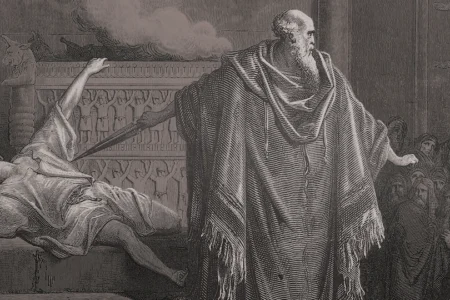
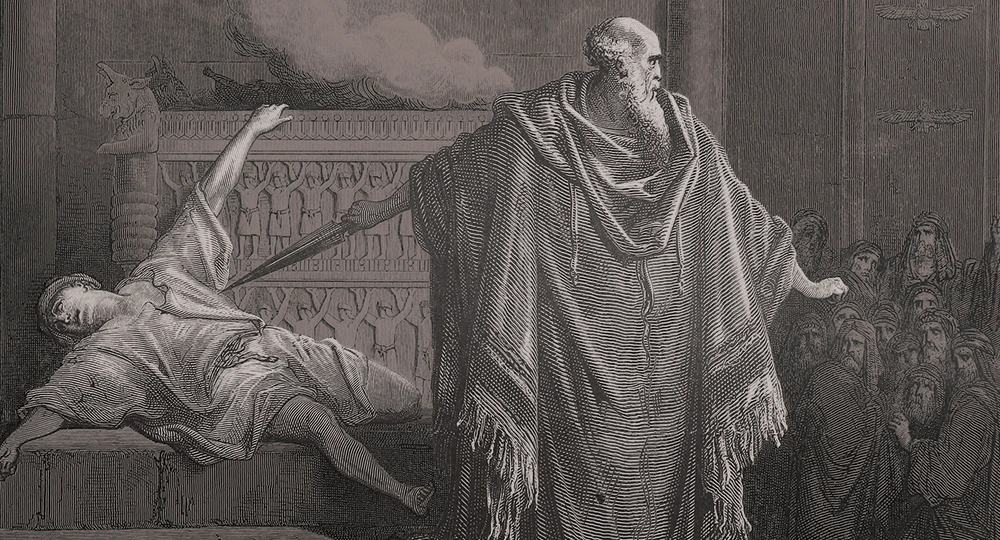
As Mattathias spoke, a Jewish man stepped forward to make the defiling sacrifice to save his life. Burning with zeal, the priest killed him at the pagan altar, then turned and killed the king’s officials. Immediately, he and his five sons fled into the Judean hills (vv. 24–28).
This was not a planned revolution; it was a moment of holy desperation. Mattathias became the spark that ignited a revolt against assimilation and annihilation. The aged priest shook his people from their slumber. A year later he died; but the revolt’s leadership passed to his son Judah, whose extraordinary military gifts earned him the name Maccabeus, “The Hammer.”
Judah the Maccabee reportedly rallied his men with words worthy of the psalms: “It is not on the size of the army that victory in battle depends, but strength comes from Heaven” (3:19). The small band of Maccabees defeated Syrian general after general. At the Battle of Emmaus, Antiochus’s General Nicanor arrived with such confidence that he invited slave traders along to purchase the Jewish prisoners he assumed he would have. Judah routed the Syrian camp at dawn and defeated him. The merchants went home with nothing (4:1–25).
The Cleansing
After three years of guerrilla warfare, Judah led his forces into Jerusalem in 164 BC and recaptured the Temple Mount. What they found was devastating.
The Temple courts were overgrown, the chambers were desecrated, and the altar to Zeus was still standing. The sacred lampstand, the table of showbread, and the altar of incense all were gone. Judah and his men dismantled the defiled altar stone by stone, built a new one from uncut stones as Jewish Law prescribes, and fashioned new sacred vessels (vv. 36–49).
Then they searched for oil to relight the seven-branched lampstand whose flame was never supposed to go dark. Finding only a single flask of oil bearing the seal of the high priest—enough to burn only one day—they lit it anyway and began the eight-day task of preparing new oil.
Miraculously, the flask of oil burned for eight days, the full time needed to consecrate more oil. On the 25th of Kislev—the very date Antiochus had desecrated the Temple three years earlier—Judah and the priests of Israel stood before a purified sanctuary, a burning menorah, and a God who had not forgotten His people (Babylonian Talmud, Shabbat 21b).
They celebrated for eight days and declared these days would be remembered in every generation: Hanukkah, the Feast of Dedication. Today it is often referred to as the Festival of Lights.
The Ultimate Kingdom Shift
At Caesarea Philippi, Jesus stood where one pagan empire had handed Israel to another in a chain of events that led to Antiochus IV and an attempt to annihilate Jewry.
The disciples knew the story of Hanukkah. And they likely understood that what the Maccabees accomplished at a moment in history, Israel’s Messiah Jesus will accomplish for eternity. Someday, He will inaugurate the ultimate kingdom shift that will topple every human kingdom and reinstitute the Kingdom of David.
He is the “stone” cut without human hands that the prophet Daniel said will lay waste to all human empires (Dan. 2:34). And His is the eternal Kingdom that will “crush all the others” and “shall never be destroyed” (vv. 40, 44).