Jesus by Menorah Light
Like His Jewish countrymen, Jesus celebrated Hanukkah. But He reframed their perspective by introducing Himself as the true source of life and light.
Growing up in a Gentile home, I knew almost nothing about Hanukkah. I was far too focused on Christmas traditions to consider why Jewish children didn’t do the same things I did. Though the traditional eight days of Hanukkah presents piqued my interest, that’s about all I knew about Hanukkah for many years.
But one day, I noticed something while studying my Bible: As an observant Jewish Man, my Savior Jesus celebrated all the Jewish holidays, even the ones that weren’t required in the Old Testament, including Hanukkah:
Now it was the Feast of Dedication in Jerusalem, and it was winter. And Jesus walked in the temple, in Solomon’s porch. Then the Jews surrounded Him and said to Him, “How long do You keep us in doubt? If You are the Christ [Messiah], tell us plainly” (Jn. 10:22–24).
Discovering that the Feast of Dedication was Hanukkah produced questions in my mind: What was Hanukkah? Why did the Jewish people of Jesus’ day celebrate a holiday that wasn’t required in the Torah? Why did Jesus travel all the way to Jerusalem to observe the holiday? Should Christians know more about Hanukkah?
The Making of a Hebrew Holiday
Many Jewish holidays were born out of an attempt to destroy the Jewish people. Often throughout history, Jewish people have been threatened with annihilation. If you study the brutal history of persecutions, confinement in ghettos, expulsions, pogroms, and the Holocaust that the Jewish people have suffered, it’s easy to see why they celebrate so lavishly. Hanukkah is no exception.
By the 2nd century BC, the Greeks had conquered and dominated much of the world, including Israel. They intentionally spread their cultural influence to cause all their subjects to become effectively Greek, a process called Hellenization. Many Jewish people didn’t Hellenize easily. In response, Antiochus IV (Epiphanes), a Greek ruler from Syria, outlawed all Jewish worship practices. He even sacrificed a pig to the Greek god Zeus on the altar in the Temple in Jerusalem, seeking to destroy Jewish culture, worship, and identity.
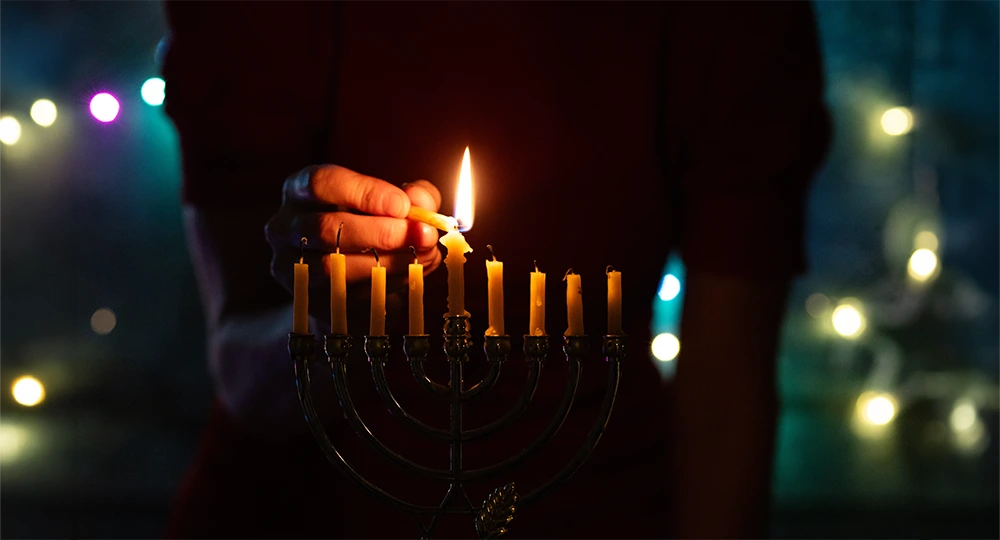
But when a group of Jewish freedom fighters called the Maccabees finally defeated the Greeks in 164 BC and took control of the Temple, they rededicated God’s house of worship and reinstituted the daily sacrifices prescribed in the Law of Moses. They also relit the lampstands, or menorahs, in the Temple and held a belated eight-day celebration of the Feast of Tabernacles, which had been neglected for three years. According to rabbinic sources, they had only enough consecrated oil to light these menorahs for one day, not the required eight days of the celebration. Since the lamps were supposed to burn continuously (Lev. 24:1–3), and it took time to consecrate more oil, God performed a miracle to make one day’s worth of oil burn for eight whole days—at least, according to the rabbis.
Interestingly, the ancient Jewish historian Josephus, who wrote around 150 years before the rabbis did, believed that the story of the oil may have been a myth invented by the rabbis. He called the celebration the “Festival of Lights,” but not because of the oil and menorah light. Josephus claimed that the Jewish people celebrated the holiday in Jesus’ time because it commemorated the return of their freedom to worship at the Temple. The “light,” according to Josephus, was defined as the freedom to worship God, blazing zealously in Jerusalem once again.
The True Meaning of Hanukkah
Jesus’ encounter with the Jewish people in the Temple shines brightly when we consider that it took place during Hanukkah, the time when Israel remembered the glorious days of revolt against Greek influence and oppression. This was a chance for the Jewish people to celebrate their single, brief period of freedom since their exile. They revered the religiously zealous warrior priests who freed them and called them to follow God wholeheartedly.
In Jesus’ day, the message of Hanukkah was that Israel should live uncompromisingly as God’s people, worshiping Him alone at the Temple. It focused on purity in Temple worship and freedom from Gentile oppression.
While Jesus walked through the beautiful colonnade in the Temple court, the people were itching for freedom and spoiling for a fight. Their words convey a greater sense of urgency with this mindset: “How long do You keep us in doubt? If You are the Christ, tell us plainly,” they told Jesus (Jn. 10:24), as if to say, “If You are the Messiah, make it clear. Set us free like the Maccabees did. We want to be free of Gentile oppression and influence. We’ll follow You into battle if You’d just tell everyone plainly who You are.” But Jesus answered,
I told you, and you do not believe. The works that I do in My Father’s name, they bear witness of Me. But you do not believe, because you are not of My sheep, as I said to you. My sheep hear My voice, and I know them, and they follow Me. And I give them eternal life, and they shall never perish; neither shall anyone snatch them out of My hand. My Father, who has given them to Me, is greater than all; and no one is able to snatch them out of My Father’s hand. I and My Father are one (vv. 25–30).
The people wanted to escape oppression, seeking a Messiah who would overthrow Rome and its influence, just like the Maccabees did with the Greeks. They also wanted the Messiah to proclaim that the Temple and zealous religious observance constituted the “light” to the world of true worship of God, which was their understanding of “the reason for the Hanukkah season,” so to speak.
But Jesus subverted His listeners’ expectations. He responded to these priorities with one central truth: “I and My Father are one” (v. 30). That means:
• He was the Anointed One (Messiah).
• Everything He did proved who He was (v. 25).
• Only His influence and voice matter (vv. 26–27).
• True worship is centered on Him (v. 27).
• Nothing will shake those who know and listen to Him (vv. 28–29).
Jesus stripped away the people’s priorities and agendas for both the holiday and the Messiah and pointed them toward Himself as the reason to celebrate. The life He offered was true, eternal freedom, not merely a temporary change in politics. He was the true Light, which gives light to everyone (1:9; 8:12). The light He offered was a perfect, unbreakable connection to God through Him, not strict religious formulas. The rededicated Temple ultimately was a symbol, rather than the substance, of true holiness and God’s presence with His people, which were all wrapped up in the person of Jesus, who had come to dwell among men (1:14).
According to Jesus, the Festival of Lights is about the light and life that only He, the Son of God, offers. He is the true fulfillment of the longing of both the Jewish people and the Gentiles. He is the reason for the Hanukkah season.
Do you hear the voice of the Messiah who has come to give light and life? If you do, you have every reason to celebrate, no matter what day, month, or season it is. We know God personally by His grace through Messiah Jesus’ work to save us and set us free.
How will you celebrate Hanukkah this December?