Iran’s Islamic Crusade
Israel My Glory In Depth is a video interview series that explores the author’s motivation in writing their article.The history of conflict between Israel and Iran
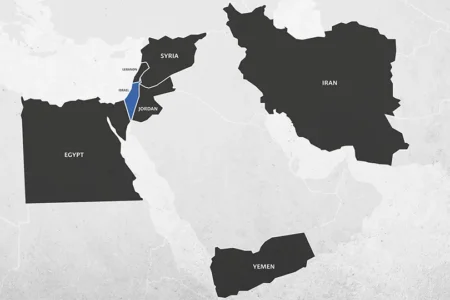
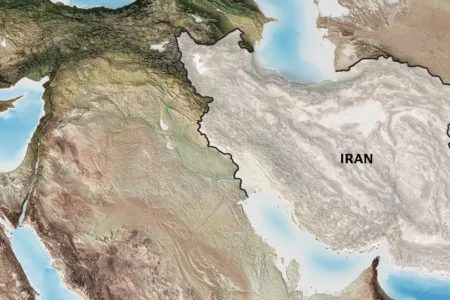
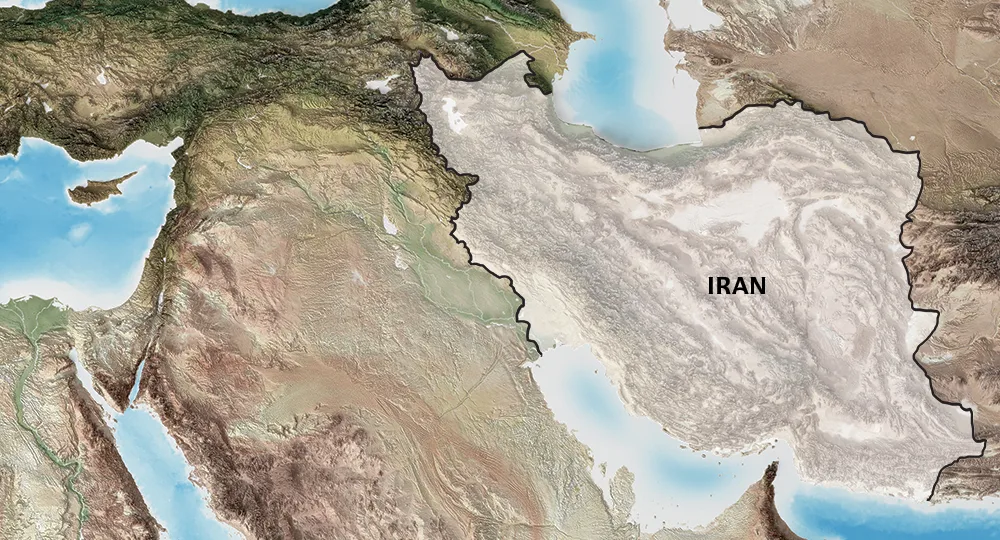
Although Iran does not border Israel and is located approximately 1,000 miles to the east, it is one of Israel’s fiercest enemies, with an established timeline of conflict with the Jewish state.1
The Modern Conflict Begins
Iran joined the nuclear age in 1967, the very year Israel won a major victory against the Islamic nations that had attacked it in the Six-Day War.
At that time, the United States gave Iran the Tehran Research Reactor under America’s “Atoms for Peace” program. Despite the call throughout the Muslim world to punish Israel for humiliating Islam, Iran, then under the leadership of the Shah (Mohammad Reza Pahlavi), remained at peace with the West and its allies, including Israel, with whom it had economic and security agreements.
However, in 1979, after 38 years in power, the Shah fled Iran because of a violent populist uprising and the Islamic Revolution, led by Ayatollah Ruhollah Khomeini. On November 4, Iranians seized the U.S. Embassy in Tehran and held 52 embassy personnel hostage for 444 days. Iran’s new theocracy was based on Twelver Shi’ism; and its apocalyptic agenda awaiting the arrival of the military “messiah,” the Twelfth Imam, targeted Israel as a major enemy of Islam, calling the United States “the Great Satan” and Israel “the Little Satan.”
Khomeini and his clerics declared themselves representatives of Allah on Earth and called anyone opposing them a mohareb, an enemy of God. The punishment was execution, and tens of thousands were executed. In response, international pressure sought to force Iran to abandon its nuclear reactor program.
The Modern Conflict Resurges
For the next 20 years, Iran built its base of operations, changing the country into a theocratic state that strictly governed the lives of every individual based on Islamic Sharia law.
Israel faced the Palestinian uprising (Intifada) under Yasser Arafat’s Fatah party (1987–2000) and Iraq’s threats of jihad and massive invasion (6-million-man army against Jerusalem). During this time, Iran continued to threaten Israel in the media while covertly building up the various jihadi factions pledged to destroy the Jewish state (Hamas, Islamic Jihad, Hezbollah, Houthis, et. al.). Also, Iran secretly continued nuclear enrichment at the Natanz nuclear facility.
In 2005 Mahmoud Ahmadinejad became Iran’s president. He also became the public face of threats against Israel and the West, especially in his October 2005 “World Without Zionism” conference that declared, “Israel must be wiped off the map”; his December 2005 statement, “We don’t shy away from declaring that Islam is ready to rule the world”; and his 2006 speech at the UN General Assembly, in which he blamed the problems of the Middle East and the world on “the Zionist regime.”
Ahmadinejad also refused to discontinue uranium enrichment and called for the coming of the Twelfth Imam, whom he called “the perfect righteous human being and the real savior”2 who, in Twelver Shi’ism, will lead the end-times invasion of Jerusalem.
That same year, he stated that the solution to the Middle East crisis was to destroy Israel. In a later speech at the UN in 2012, Ahmadinejad claimed the “sweet scent” of the Mahdi’s (Twelfth Imam’s) global reign “will soon reach all the territories in Asia, Europe, Africa and the U.S.” He developed a documentary that was shown to Iran’s military called The Coming Is Soon, with a filmed, mock invasion of Israel led by the Twelfth Imam.
The Modern Conflict Escalates
Over the years, various Iranian leaders have called Israel a “cancerous tumor” that will be cut out; and in 2012, Iran’s Supreme Leader Ayatollah Ali Khamenei declared, “In any place, if any nation or any group confronts the Zionist regime, we will endorse and we will help.” He openly affirmed Iranian policy (rarely stated explicitly) to assist Hezbollah and the Palestinian Hamas and called Syria Iran’s greatest ally in the Arab world.
Former Iranian President Akbar Hashemi Rafsanjani wanted to use nuclear weapons to destroy Israel, which he said was a small country that could not sustain a nuclear attack by a larger country. He said Iran was willing to pay the price of collateral damage from a nuclear exchange in order to exterminate the Jewish state.
Believing Iran’s threats to destroy Israel and the West, the international community in July 2015 backed a comprehensive nuclear agreement limiting Tehran’s uranium enrichment in exchange for lifting economic sanctions.
In 2018, Israeli Prime Minister Benjamin Netanyahu frequently appeared before the UN General Assembly warning of Iran’s deception. He pointed out that Iran concealed its continued nuclear program, both before and after it signed the agreement with world powers. The confirming data, obtained by non-Israeli agents in Tehran, led U.S. President Donald Trump to unilaterally withdraw the United States that same year from the nuclear deal with Iran, hoping to stop Iran’s nuclear program.
From 2020 to 2022, several attacks on Iran’s nuclear project were blamed on Israel, from a centrifuge production plant explosion to the assassination of the scientist who founded Iran’s military nuclear program to an attack on the underground nuclear facility in Natanz to the poisoning of two Iranian nuclear scientists. Ignoring the world’s consensus, Iran began enriching uranium up to 60%, a technical step away from weapons-grade levels of 90%.
Further escalation came with Hamas’s October 7, 2023, massacre of 1,200 Israeli civilians and its taking of 251 hostages. Iran armed and trained Hamas for this attack and supported it in its war against Israel with the goal of asserting Islamic control over all of Jerusalem.
In February 2024, Israel sabotaged an Iranian natural-gas pipeline and in April launched an airstrike against Iran’s consulate in Damascus, killing two Iranian generals. The same month, Iran fired more than 300 missiles and attack drones into Israel. Israel retaliated, striking an air-defense system near an airport in Isfahan and assassinating Hamas leader Ismail Haniyeh in Tehran (July) and Hezbollah leader Hassan Nasrallah (September).
In October, Iran launched its second direct attack on Israel. Later that month, Israel killed Hamas leader Yahya Sinwar in the Gaza Strip and attacked Iran directly for the first time, targeting air-defense systems connected to the missile program. On April 6, 2025, Iran supported a fatwa (religious order binding on all Muslims) by the Qatar-backed International Union of Muslim Scholars calling for armed jihad against Israel3 and initiated more drone attacks on Israel.
From June 13 through 15, 2025, Israel launched air assaults on the heart of Iran’s nuclear and military structure and its energy industry across the country; and on June 22, the United States bombed three nuclear sites in Iran.
Where Are We Now?
Despite massive damage to Iran’s nuclear facilities, Amir Mousavi, former Iranian presidential advisor and foreign minister, said in August 2025 that Iran can build 18 to 24 nuclear bombs and “go nuclear within hours.”4
On October 31, Iranian General (Ret.) Rahim Noei Aghdam declared Iran can launch an intercontinental ballistic missile attack into the heart of America and has surprise plans to eliminate Israel.5 In December, unusual activity linked to the Islamic Revolutionary Guard Corps Air Force was detected; and Iran confirmed it had conducted nationwide ballistic missile tests.6
In February 2026, Iran and the United States discussed lifting American sanctions on the Islamic Republic in return for Iran curbing its nuclear program. Iran firmly refused to halt its nuclear production, leading Israel and the United States to launch a joint attack that reportedly killed Iranian Supreme Leader Khamenei, President Ahmadinejad, and many of their potential successors.
At the time of this publication, the situation is rapidly developing. Iran has sworn revenge on Israel and the United States as it determines its next steps. As U.S. Ambassador to Israel Mike Huckabee stated, Tehran seeks not only to undermine and destroy Israel, but its “ultimate objective is the United States.”7
Now, it is a matter of waiting and watching, confident that God has His own timetable for Israel and the nations.
ENDNOTES
-
- Associated Press, “Timeline of Tensions and Hostilities Between Israel and Iran,” June 15, 2025 (tinyurl.com/iran-isr).
- “Transcript of Ahmadinejad’s U.N. Speech,” NPR, September 19, 2006 (tinyurl.com/UN-Ahmj).
- Special Dispatch No. 12209, “The Iranian Regime’s Support for the Fatwa by the Qatar-Backed International Union of Muslim Scholars (IUMS) Calling for Armed Jihad Against Israel,” MEMRI, October 10, 2025 (tinyurl.com/MEMRI-fatw).
- Special Dispatch No. 12149, “Amir Mousavi, Former Iranian Presidential Advisor and Foreign Minister: Iran Can Build ‘18–24 Nuclear Bombs’ and ‘Can Go Nuclear Within Hours,’” MEMRI, September 3, 2025 (tinyurl.com/Iran-nuc24).
- “IRGC General (Ret.) Rahim Noei Aghdam: We Have Missiles With Ranges of 13,000–23,000 Kilometers, and Can Launch an ICBM Attack in the Heart of America; The Days When Americans Could Attack Somewhere and Return Home as Heroes Are Over,” MEMRI TV, October 31, 2025 (tinyurl.com/MOS-tvtel).
- “Iran Confirms Ballistic Missile Tests in Several Locations Across the Country,” i24NEWS, December 22, 2025 (tinyurl.com/Confirm-1).
- “‘Iran’s Ultimate Goal Is to Destroy the United States,’ Says Amb. Huckabee,” i24NEWS, December 22, 2025 (tinyurl.com/Huck-goal).
-