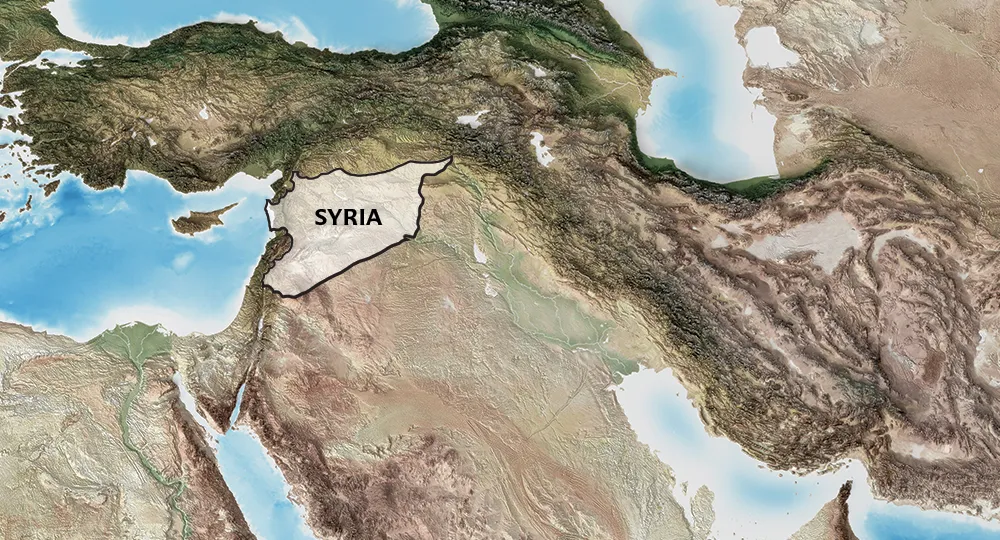
Syria: Israel’s Implacable Adversary
A look at the country that still wants the Golan
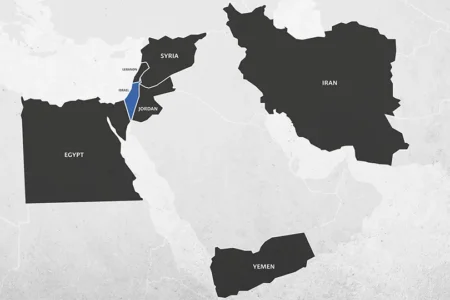
Israel’s relationship with Syria has been a rocky one, to put it mildly. Though the modern iterations of both countries have their birthdates in the latter half of the 1940s (Syria in 1946, Israel in 1948), Syria has never accepted the existence of its Jewish neighbor to the southwest and works continuously to stamp out the little country.
One day after Israel gained its independence in May 1948, five Arab armies, Syria among them, launched an assault aimed at strangling the Jewish state in its cradle. After more than a year of fighting, Israel decisively defeated the Arabs; and all but one of the Arab nations signed armistice agreements.
Syria signed on July 20, 1949—but only after extensive debate over parcels totaling roughly 25 square miles of land that had been promised to Israel in the United Nations’ 1947 Partition Plan.
To halt hostilities between the two nations, the parties agreed that these disputed areas would become demilitarized zones (DMZs). Additionally, a buffer zone was created between the two countries, where UN truce monitors were to ensure no violation of the armistice occurred.
Unfortunately, the armistice did not bring lasting peace or solve the conflict. As historian Sir Martin Gilbert noted, “Like the other armistice agreements, the one between Israel and Syria was intended to lead to an eventual peace treaty, but did not do so. Damascus . . . remained the implacable adversary of the very concept of a Jewish State.”1
Over the next 18 years, tensions ran high as disagreements arose over the DMZs. Since the UN partition plan gave Israel territorial sovereignty, Israelis considered the land theirs. Syria, however, did not want any Israeli activity in the area, including civilian; and the country made that position clear by repeatedly breaking the armistice agreement. In the 1950s, Syrian forces routinely fired on fishermen, farmers, and other Israeli civilians.
In late 1964, Syria developed plans to divert two of the Jordan River’s sources, the Hasbani River and the Banias River, to cut off one of Israel’s major water sources. After Syrian earthmovers were spotted near the planned site of a canal that would divert the Banias from Israel into Jordan, Israeli tanks destroyed the machines with direct hits.2
Throughout the years, Syria has routinely attacked villages in northern Israel. Most notably, on April 7, 1967, Syria rained down mortars on Kibbutz Gadot from its vantage point on the Golan Heights and shelled nearby Israeli farmers on tractors working in the fields. The attack on Israeli civilians led to a daylong skirmish. Israeli tanks fired on the Syrian positions, and the Israeli Air Force made 171 sorties against Syria.3
Though the fighting ended that day, hostilities only intensified, as Syria permitted and encouraged Fatah, the Palestinian National Liberation Movement, to use its border to cross into Israel for terrorist campaigns. By the beginning of June 1967, the situation had escalated into a major regional conflict—the Six-Day War.
Rumors had spread throughout the Arab world (echoed by the Soviets) that Israel was planning a war against Syria. However, Egypt, Jordan, and Syria had mobilized to wipe out the Jewish state once and for all.
But Israel did not wait to be attacked. On June 5, 1967, it launched a preemptive strike, sending out 185 fighter jets to destroy the air forces of their Arab enemies before enemy planes could even get off the ground.
Five days later, Israel again had won a war meant to annihilate it. In the process, Israel also captured more land, including the Golan Heights from which Syria had for so long launched attacks on Israeli civilians.
Terrorism, supported by Syria and other Arab nations, continued following the Six–Day War. Syria permitted Fatah to continue cross-border attacks into Israel. It hosted the leadership of the Palestine Liberation Organization (PLO) and permitted the PLO to use Syria as a base of operations against Israel.
Things came to a head on October 6, 1973, when Syria and Egypt surprised Israel with a coordinated attack that almost destroyed the tiny Jewish state. In what became known as the Yom Kippur War, Israel’s 170 tanks stationed in the Golan Heights were overwhelmed by 1,400 Syrian tanks that moved across the Golan at lightning speed.4 Eventually, more Israeli forces reached the Golan and halted the Syrian onslaught. Israel won the war—but barely and at tremendous loss of life.
Since then, Israel and Syria have not officially been at war, but neither have they been at peace. Syria routinely backs Israel’s enemies, including Lebanese militias (Lebanon War, 1982) and Iran and Hezbollah.
Since the fall of former Syrian President Bashar al-Assad in 2024, Israel has established nine bases on the Syrian side of the Golan Heights to block Iranian proxies from operating there and to prevent Iran from transferring weapons to Hezbollah in Lebanon via Syria.
In 2025, in response to Syrian attacks on Druze communities and the resulting outrage among Israeli Druze, Israel carried out more than 160 airstrikes on military targets in Damascus and Sweida to protect the Druze population.5
Though born only two years apart, Syria and Israel could not be more different: One builds, protects, and seeks peace; the other wastes its strength on destruction, threatening both its Jewish neighbor and its own people.
Had Syria chosen cooperation over annihilation, the Middle East might be a better place for Jews and Arabs alike.
ENDNOTES
-
-
-
- Martin Gilbert, Israel: A History (New York, NY: William Morrow and Company, 1998), 255.
- Ibid., 353–4.
- Simon Plosker, “The Dogfight of April 7th, 1967,” HonestReporting, March 6, 2017 (tinyurl.com/Dogfight67).
- Gilbert, 427, 430–3.
- “Who Are the Druze, and Why Is Israel Defending Them in Syria?” American Jewish Committee, July 24, 2025 (tinyurl.com/WhoDrz).
-
-