Looking to Jesus—for Everything (Zechariah 12:10-13:9)
Israel My Glory In Depth is a video interview series that explores the author’s motivation in writing their article.Israel doesn’t understand who Jesus truly is. But the day is coming, . . . and it will be glorious.
Evangelist Billy Graham once said, “God’s forgiveness is not just a casual statement; it is the complete blotting out of all the dirt and degradation of our past, present, and future.”1 That is what God does for all of us who have accepted Christ as our Savior, and that is what He will do someday for the nation of Israel.
God promises to bring Israel to repentance and cleanse it of sin. But first, the nation will suffer through a time of great trouble and testing.
The Stroke of a Sword
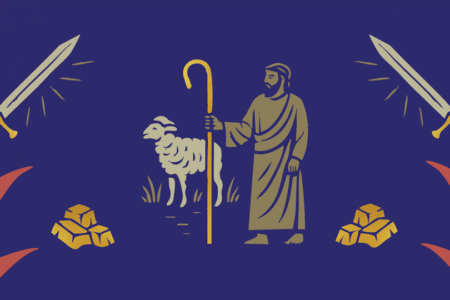
In Zechariah 13:7, God calls for a sword:
“Awake, O sword, against My Shepherd, against the Man who is My Companion,” says the LORD of hosts. “Strike the Shepherd, and the sheep will be scattered; then I will turn My hand against the little ones.”
As in Ezekiel 21:3–5, the sword belongs to God. Zechariah, who prophesied about 500 years before Christ was born, spoke futuristically. Yet, from our perspective, his prophecy is historical. God’s Shepherd is Messiah Jesus, who referred to Himself as “the good shepherd” who “gives His life for the sheep” (Jn. 10:11). God did indeed strike His Shepherd, and “it pleased the LORD to bruise Him” (Isa. 53:10).
We know that Jesus “came to His own, and His own did not receive Him” (Jn. 1:11). In fact, the Jewish leaders, who represented the nation of Israel, “killed the Prince of life” (Acts 3:15) and became “the betrayers and murderers” of “the Just One”—just as they killed the Jewish prophets who preceded Him (7:52). They demanded Messiah’s death, and the pagan Romans cooperated by crucifying Him.
Ultimately, God engineered the entire event. Yet, national Israel was also culpable (cf. Rom. 11:11). Rejecting their Messiah when He finally came, even to the point of death, was the worst sin God’s Chosen People could have committed.
Jesus foresaw the event and quoted Zechariah to His apostles before His arrest: “All of you will be made to stumble because of Me this night, for it is written: ‘I will strike the Shepherd, and the sheep will be scattered’” (Mk. 14:27).
The Consequences
The sheep were scattered. Not only did Jesus’ apostles flee, but God also passed judgment on the Jewish people and scattered them throughout the world (cf. Dt. 28:63–64).
But that’s not all. He declared a future, more severe consequence for Israel’s sin: “Then I will turn My hand [direct My power] against the little ones” (Zech. 13:7). Who are the “little ones”? There are a variety of opinions; but the context seems to point to the “little ones” of the “sheep,” meaning Israel’s population.
The prophet Jeremiah spoke of “the time of Jacob’s trouble” (Jer. 30:7). During that awful period, two-thirds of Israel’s population will be killed,2 along with billions of Gentiles. But God guarantees that a third, the “little ones” of Israel’s flock, will survive the horrors (Zech. 13:8). This remnant will be refined into a “meek and humble people” (Zeph. 3:12).
God’s purifying process will take place in the “furnace of affliction” (Isa. 48:10), which always has a twofold purpose: to purge impurities and to prepare people for holy service (Prov. 25:4; Isa. 1:25; Mal. 3:2–4). Israel’s purging and refining will lead to its cleansing (Dan. 12:9–10). But repentance must come first.
Sincere Contrition
Moses predicted that in the latter days, when Israel is in deep distress, it will return to the Lord (Dt. 4:30). Part of that distress will involve a global attack on Jerusalem (Zech. 12:3; 14:2).
To Israel, it will seem like certain annihilation awaits the nation. But God will intervene on His people’s behalf, not merely to rescue them physically (14:3), but also to save them spiritually.
First, “the sign of the Son of Man [Jesus] will appear in heaven, . . . and they will see the Son of Man coming on the clouds of heaven with power and great glory” (Mt. 24:30).
Then God will pour out on the remnant of Israel3 His Spirit of grace and supplication (Zech. 12:10; cf. Rom. 8:26; Heb. 10:29). This unconditional, causal act of God will have a specific purpose: It will enable Israel to look not merely on someone, but to Him for their confidence and rescue, in the same way they “looked to the bronze serpent” in the wilderness and lived (Num. 21:9, LSB; cf. Jon. 2:4; Jn. 3:14).4 “Then they will look on Me whom they pierced. Yes, they will mourn for Him as one mourns for his only son, and grieve for Him as one grieves for a firstborn” (Zech. 12:10).5
Who is Me in Zechariah 12:10? The speaker is Yahweh (v. 1). When did Israel ever pierce Yahweh? On the cross (Jn. 19:34–37). Rome would not have crucified Jesus had Israel’s leaders not insisted (cf. Mk. 10:33; Jn. 18:35).
When national Israel finally realizes that Jesus is its Deliverer and that it denied Him for thousands of years, the nation will feel the weight of that guilt, which will produce a godly sorrow that leads to repentance (cf. 2 Cor. 7:10).
Like the apostle Peter, who denied the Lord immediately before Christ’s crucifixion and then wept bitterly (Lk. 22:55–62), so, too, will Israel’s survivors mourn bitterly over what they did to their Messiah. Their mourning will be so intense it will feel like losing an only, firstborn son (Zech. 12:10–11). The mourning and repentance will take place on an individual basis (various families and wives mourning by themselves, vv. 12–14).
Spiritual Cleansing
God’s response to Israel’s repentance will be spiritual cleansing, both individual and national: “In that day a fountain shall be opened for the house of David and for the inhabitants of Jerusalem, for sin and for uncleanness” (13:1), so that the people can be forgiven of their sins and sanitized of their corruption (cf. Ezek. 36:25).
God promises to remove the names of the idols that so frequently caused Israel to stumble (cf. Ps. 106:34–39). They won’t even be remembered (Zech. 13:2).
He also will remove all remaining false prophets (Jer. 23:13–22). No longer will they deceive the people (Zech. 13:4). These false prophets will be so ashamed that they will lie about their former occupation, as well as about any bodily scars they have from pagan rituals (vv. 5–6; cf. 1 Ki. 18:28). Then those who still try to prophesy falsely in the Lord’s name will be executed (cf. Dt. 18:20; 1 Ki. 18:40), even by their own parents (Zech. 13:3).
Finally, God will remove the unclean spirit from the land, the demonic spirit that influenced the false prophets and polluted the people (v. 2; cf. Ezek. 36:17–18).
Blessed Consolation
After all the purging and refining, Israel’s remnant will call on the Lord for physical deliverance (cf. Joel 2:32). But God’s people also will find spiritual deliverance. They will take comfort in knowing they have been forgiven for all they did in the past and that a new, fresh relationship with the God of their fathers will now begin.
God will completely blot out all the dirt and degradation of Israel’s past, present, and future. Then, “they will call on My name, and I will answer them. I will say, ‘This is My people’; and each one will say, ‘The LORD is my God’” (Zech. 13:9).
ENDNOTES
-
-
-
- Billy Graham, cited in “Forgiveness: Finding Freedom, Moving Forward,” Billy Graham Evangelistic Association, August 21, 2024 (tinyurl.com/Graham-Forgiveness).
- Zechariah 13:8 says this will happen “in all the land,” a phrase that could restrict the killing to Israel’s geographic borders; or it could mean the global Jewish population.
- The house of David and Jerusalem’s inhabitants are representative. The entire remnant of Israel, wherever it is located around the world, will receive this outpouring (cf. Ezek. 39:29).
- “To” is the better rendering of the Hebrew preposition לֶא in these contexts.
- “Pierced” indicates a deadly thrusting through (cf. same word in Zech. 13:3).
-
-